QUEEN STREET
The origins of its town
Accidental city?
From First Peoples' meeting place
to mandatory Megacity
|
|
Accidental city? From First Peoples' meeting place
|
|
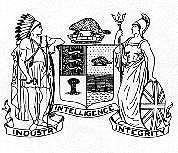
All cities are born of circumstance, in the interplay of lives and land. Sometimes, as Professor Glazebrook suggests, they are dropped on the land by distant powers. His 1971 story of this town, the line above his opening, begins as do many histories of colonized lands: with the arrival of its colonizers. But human engagement is also shaped by the land itself: its fertility; its coves and valleys; its rises and falls and natural routes. Especially water routes: settlements often sprout beside rivers, lakes, and seas. They flourish when set where routes converge: where overland paths meets water, even where paths intersect on the ground. At crossroads, river junctions, sheltering harbours, people meet to trade goods, lore, tales of places near and far; even to share cultures. Near a sandbar-cupped shore where rivers feed a lake, link in a vast chain leading to the heart of North America, peoples have crossed paths for more than 10,000 years. Hunter-gatherers at first, in time some settled, others still coming to trade. One of those trading nations, the Wendat (the French named them Huron), would call that place "meeting place of the waters," in their language "toronto." The mix of hunting, settled agriculture and trade made these people, as Rodney Bobiwash wrote, "the original 'affluent society.'" With those "virgin" forests in fact carefully tended, more than 400 plants used as food, medicine and material for everything from baskets to snowshoes; with abundant fish and game; with goods brought by trade spanning the continent (local digs have unearthed artifacts made by Pacific coast tribes), these first peoples had "the luxury of developing complex and sophisticated ceremonial lives." In tales of their Great Migration to these lands, the Anishnawbe spoke of a "turtle shaped island linked to the purification of the Earth," a land where "food grows on water" (another possible meaning of "toronto": "trees standing in water"). It may not be what we have since called The Island, but its sandy hook is a place known for centuries. That vast trade network brought European goods before Europeans in person. The first to gaze upon Lake Ontario, in 1615, was Etienne Brulé, a 23 year old coureur de bois sent by Samuel de Champlain to trace le passage de Toronto, leading south to the lake from Huron land on Georgian Bay. A dozen Wendat had led the way, on a route that (as historian Percy Robinson would say) "possessed a permanence very different from casual paths through the forest; it was as old as human life in America." It was not the only one: the modern routes of Davenport, Dundas, Lake Shore, even Yonge trace -- if most in dead straight asphalt -- what were once native routes. The French called the Anishnawbe "Mississauga." (I won't here, its local meaning now suburban: the City of Mississauga, booming to Toronto's west; to some it's "Mr & Mrs Sauga.") Their traders and missionaries also found Senecas on the Rouge to the east, at Ganatsekwyagon -- speaking an entirely different language: theirs Iroquoian; the Anishnawbe's a local dialect of Ojibwa, Algonquian. West up the Humber was Teiaiagon, near Adoopekog (later Etobicoke, the k silent); at its mouth in 1750 the Frech built a fort. Finding it too small they built another to the east, its site marked near the foot of Dufferin by a street called Fort Rouillé. Nine years later they burned it, leaving the British charred rubble. If by September 1760, all of Canada too. The French did not plan to settle this land as they had the lower St Lawrence, content to trade with (and as possible convert and "civilize") native peoples. And intent, by alliances with them, on securing trade against Dutch and English rogues. For some years the British too had minded business: the Royal Proclamation of 1763 recognized native nations as sovereign, protected by the Crown from rapacious colonials hungry for land. Not that all went well under either British or French protection: in the 1640s some 65,000 indigenous people lived in the area; half died in epidemics of European disease. They were also attacked by southern Iroquois invading from across the lakes, in 1649 bent on destruction of their ancestral enemies (if linguistic kin) the Wednat, now mortally weakened. Just 1,000 survived; the nation of Huronia lay in ruins. The next century and beyond saw varied alliances: native nations, French, and British against others British, French, native -- and in time American. With the US war came Loyalists fleeing to land still under Crown control. The British, being gentlemen, didn't take tribal land: they bought it fair and square. Or so it seemed: peoples wracked by war and disease had little bargaining power. In 1787 the Anishnawbe got 1,700 pounds sterling and $8,500 in cash and goods ("fifteen laced hats, four dozen black silk handkerchiefs, a gross of butcher's knives with red handles, blankets, scissors, powder, and shot") in exchange for some 250,000 acres of their land. The Toronto Purchase ran 14 miles west from Etobicoke Creek, 28 miles north from the shore, its southern reaches now straddled by the modern city -- a city that, as John Ross Robertson said in his 1898 Landmarks of Toronto, "seems cheap at the price. And if the landless men protested afterwards, the answer must have been 'So what?'" The landless did protest. The document formalizing the sale had "omitted a description of the area surrendered"; in 1794 it was declared invalid. In 1916 an inquiry would deem the land still formally unsurrendered; it would remain so until new treaties were signed in 1923. In the meantime the Anishnawbe reasserted claim to the Toronto Islands and, in 1860, to their historic council grounds -- occupied since 1845 (and still, with a whitewashed name) by the Provincial Lunatic Asylum on Queen Street. (Well, so what?) In 1805 they had ceded further lands, if hoping to retain fishing rights at the mouths of some creeks, as Colonel John Butler had promised in the name of "our father the King" on the land ceded in 1787. Robertson reports them saying:
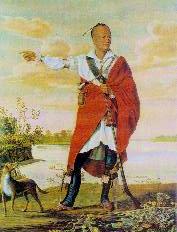
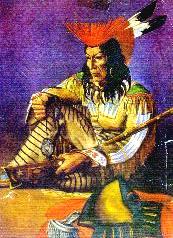
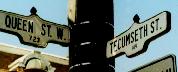
William Clark, who negotiated the 1805 deal with the Anishnawbe at the mouth of the Credit River (now in Mississauga), found them "thin and miserable." Their land "lay dead." The Shawnee chief Tecumseh was then building a new Indian confederacy from Canada to the mouth of the Mississippi, hoping to stem America's march to the west. In the War of 1812 he sided with the British, on General Sir Isaac Brock's promise that Michigan once British again would be Indian territory, its people protected by the Great Father in London. Detroit fell to Brock in August 1812 without a shot fired, the Americans so fearful of his Mohawk allies they surrendered. The Mohawk were also vital to victory at Queenston on the Niagara River; Brock died there. The US Navy later captured Lake Erie; fearing they'd be cut off at Detroit the British abandoned it, retreating east under Colonel Henry Proctor. Tecumseh, betrayed, defended them still, falling at the Battle of Moraviantown near London, Ontario, more than an hour after Proctor had fled the field. Dying with him (his body never found) was his dream of First Peoples united on their own land. He did get a Toronto street, at least in name, south off Queen west of Bathurst. The Americans got Michigan. In the Treaty of Ghent the British abandoned their once valued allies, native peoples left to their fate. Many still live on the Six Nations Reserve near Brantford, named for Joseph Brant, Mohawk chief and British ally who led them there in 1784, refugees from upstate New York; their settlements had been burned by order of George Washington. More live in Toronto, nations in diaspora on their own land.
| ||
|
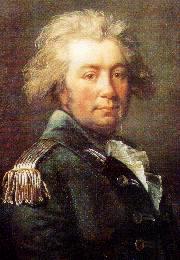
If no fluke as a meeting place, this city can fairly be called an accidental capital. It was no one's first choice, just second best; the legacy would linger. Sir Guy Carleton, later Lord Dorchester (he got a Toronto street too, though we spell it Carlton), became Governor General of conquered Quebec in 1768. He soon gave up thoughts of swamping the Canadien majority. Back in London he lobbied for the Quebec Act of 1774, making them "British" by recognizing their language, religion, and civil law. George III suddenly had 65,000 French Catholics as more or less loyal subjects -- and a few million North Americans suddenly less loyal. The Quebec Act had also reclaimed as part of Quebec all of old French Canada, down to the southern tip of what is now Illinois. For the 13 Atlantic colonies it was a roadblock to what, in time, they would call their Manifest Destiny. With that shot heard round the world in April 1775, they set out to claim it in blood. Most Loyalists fleeing the Revolution headed for what was then Quebec -- where they risked being swamped by Canadiens. In 1791 it was split at the Ottawa River. To the east was Lower Canada, still French. The rest, less old Quebec south of the lakes, gone to the US, became Upper Canada. And English. Carleton wanted Upper Canada's capital to be Kingston; looking at Kingston you can tell: its limestone still rises in grand aspiration. But it had too many Americans of dubious loyalty, more (of sure sentiment) just over the river in New York. The only other town of any size was on the Niagara River -- across from the towering Fort Niagara: built French, become British, now American. Nonetheless, it was at Niagara (renamed Newark; now Niagara on the Lake) that Upper Canada's legislature met in 1792 under its first lieutenant governor, John Graves Simcoe. Colonel of the loyalist Queen's Rangers -- a British soldier to the bone, thrice wounded by American rebels -- Simcoe wanted a capital well beyond the range of US cannon. His choice: the forks of the Rivière la Tranche, renamed the Thames; there he would set "the Capital I mean to call Georgina." Or New London. Now just London (Ontario). Carleton already had the Toronto Purchase, between Niagara and Kingston, away from the Americans, and with a defensible harbour. Simcoe went to check it out and admitted it would do -- temporarily. He ordered a plan (in which Queen Street makes its début as an unnamed survey line), sent Rangers to cut trees and build huts meant to become a fort. If not one called Toronto. On August 27, 1793, to a peal of cannon honouring the Duke of York (victor of a recent battle in Holland and no stranger to Simcoe), the colonel -- who ever disdained native names -- christened the place the Town of York. It had, by one account, not yet a single house; another says there were 12. Still, by 1794 it was the capital, securely if not to joy all around: officials lured from the relative comforts of Newark by the promise of free "Park Lots" got them -- if still crabbing on at roughing it in the bush. Simcoe, his wife, infant daughter, and young son Francis first set up vice-regal residence in a "canvas house," a tent that had travelled with Captain Cook. Later, far north on land the governor granted himself in his son's name, they built a cabin made classic with pillars of logs: Castle Frank; gone by 1829, accidentally burned, but since recalled in a street and a subway station. From there Elizabeth Posthuma Simcoe could see "the colour and mystery of the scene as Indian braves speared salmon from canoes at night by the light of flares" on the Don (if likely to them the Wonscoteonoch). Mrs Simcoe, ever resilient, kept a journal and liked to paint; we have her to thank for early views of this land, in watercolour and words. She and John sailed off in 1796, he in poor health if serving nine months of 1797 as governor of St Domingo (now Haiti). Named commander of India in 1806 he fell sick on the way, turned back, and died at home in Exeter. Elizabeth lived on until 1850, among her surviving children; she'd had eleven. Baby Katherine lies in York's military burial ground, its stones too worn to say exactly where. Frank died young, fighting Napoleon's forces in Spain. So, a short sojourn for the Simcoes, the colonel not always kindly treated by historians. W L Morton has called him "an energetic man, full of bounce and enthusiasm," if with "a limited sense of reality; one wonders that the colony came to so little harm at his hands." Contemporaries could agree, one telling a friend in a letter of 1793:
Simcoe himself wrote in 1798 of his confidence that Upper Canada "will be with proper & honourable support, the most valuable possession out of the British Seas, in population, commerce & principle of the British Empire."
|
|
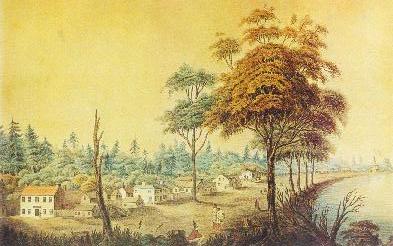
The Town of York, 1804
"Part of York the capital of Upper Canada on the Bay of Toronto in Lake Ontario," by Elizabeth Francis Hale.
In the foreground: Front Street, for which Simcoe ordained "a certain Order of Architecture." Notable residents, in the last two houses to the right: William Allan (later of Moss Park & the Allans of Allan Gardens) & Peter Russell (of Peter & Russell streets).
Far right, near the flagged blockhouse: two modest brick buildings, seat of the provincial parliament burned by American troops in 1813 -- avenged by the British burning the President's House in Washington. |
|
Simcoe had left behind a town determined to do him proud. It survived brief American occupation in 1813; invasion by the farmers of North York in the Rebellion of 1837; epidemics of cholera in the 1830s, typhus later, if with far more deaths from disease than war; and a Great Fire (with another to come). It even survived the ignominy of being, for a time, capital of nothing at all. It had become a city in 1834, first in the province, reclaiming the ancient name of Toronto. But with the 1841 Act of Union, Lower and Upper Canada became the single Province of Canada, its parts East and West marking mere geography, not governance. The deal included Responsible Government -- vice-regal appointees accountable to local legislators, not the Colonial Office in Whitehall -- and yet another attempt to swamp the French. Its first capital was Kingston, then Montreal. From 1849 to 1851 parliament did camp out in Toronto: Tory Montrealers, upset with the Reform government for "rewarding traitors" with the Rebellion Losses Bill, had torched its "French house." In 1857 the capital came back to Toronto -- if not for long. Queen Victoria, asked to pick the site for a permanent seat of government, chose an overgrown lumber mill on the river between East and West: Bytown. Become Ottawa, Bytown was by 1859 capital of the Province of Canada; from Confederation in 1867 of the entire Dominion of Canada. East was severed from West again (a chief goal of the West's Protestant Anglo majority); they became Quebec and Ontario. Toronto was again a capital, if of just one province of four, in time one out of ten.
| ||
|
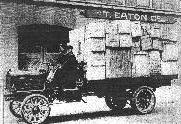
Well, no matter; Toronto had other business: Business. Famously, even notoriously; as a later joke would have it: Toronto is where people say, "Thank God it's Monday." Leaving steel's fire and smoke to Hamilton up the lake, later car and truck plants east and west to Oshawa and Oakville, Toronto favoured light industry: farm equipment (Massey), apparel (Eaton's), boilers, pumps and domestic appliances (Inglis), processed foods (Weston's), whisky (Gooderham's), beer (O'Keefe's; Molson's, also a bank), a raft of other manufactures. And meat packing: hence Hogtown. But the town would most honour its roots in trade. Eaton's, to most Canadians, was its mail order catalogue. The wealth of forests and mines (none of course in town) piled up on Bay Street, overtaking Montreal's St James as Canada's capital of finance -- even though Montreal was long its biggest city. Toronto fat cats saw the rest of Canada as their hinterland; its bankers, publishers, broadcasters, artists and ad execs dominated the commerce and culture of the entire nation, apart from Quebec. Hence... Hogtown. Dissing Toronto has long been Canada's top sport -- even among Torontonians. "By tradition," Bob Fuldord has said, we "silently agree that to declare oneself proud of the city is to step dangerously close to gaucherie." But its citizens have mostly just got on with business. And bigness: from the highest cathedral spire (St James') to the widest highway (the 401) to the CN Tower, tallest freestanding structure in the world. Long second best -- to Kingston even, Montreal, now New York -- we ever try harder. And get bigger. The Town of York's few settlers became by 1834 the City of Toronto's 10,000 (or nearly); by 1910 some 350,000; during World War Two nearly twice that. The central city grew little more but its suburbs boomed: Etobicoke, North York, and Scarborough far east ("Scarberia") had doubled their combined wartime population by 1950. In 1953 they all became part of the one of the earliest urban regional federations: the Municipality of Metropolitan Toronto, then with just over a million residents. By 1976 Toronto had surpassed Montreal as Canada's biggest metropolis. The City of Toronto is now all of what was once "Metro," its 2.4 million citizens forced in 1998 by Ontario's Tories into a single "megacity" -- now the fifth biggest municipal jurisdiction in North America (Mexico City, New York, Los Angeles, and Chicago the only ones bigger), core of a vast conurbation home to nearly five million people. Not that we brag. Or not many of us: more than 75 percent of Toronto's mere citizens voted No to Megacity. We got it anyway, Canadian cities mere pawns of provincial masters. Whether we like it or not, our town is -- or as ever is trying hard to be -- "World Class." If, so far, held hostage by parochial pols once so aptly characterized by Jane Jacobs: "They're nitwits." Many of us, though, are not.
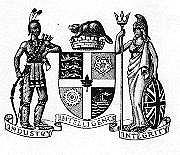
See more on: Elizabeth Simcoe & her tales of the Don, in Of time & the river. The Rebellion of 1837 & Responsible Government, in Losers -- Who sometimes win, an addendum to Promiscuous Affections, & here on Queen in Streets of faith. Sources (& images) for this page: John Ross Robertson: Landmarks of Toronto, (GET pubn data), 1898. Percy Robinson: Toronto during the French Regime, 1933 (quoted in Toronto: No Mean City*). Eric Wilfrid Hounsom: Toronto in 1810, Ryerson Press, 1970. John Robert Colombo (ed): Colombo's Concise Canadian Quotations, Hurtig Publishers, 1976. Lucy Booth Martin: A View of Original Toronto: The Fabric of York / Toronto circa 1834, Paget Press, 1983 (1834 & 1961 coats of arms). Carl Benn: Historic Fort York, 1793 - 1993, Natural Heritage / Natural History Inc, 1993 (Simcoe, 1791; York, 1804). A Rodney Bobiwash: "The History of Native People in the Toronto Area: An Overview," in The Meeting Place: Aboriginal Life in Toronto, Heather Howard- Bobiwash & Frances Anderson (eds), Native Canadian Centre of Toronto, 1997. CBC Televison: Canada: A People's History, 2000. Toronto Reference Library Picture Collection (Tecumseh & Thayendanegea). * For sources cited throughout, see Life on the street.
Go on to: A line on a map Logic confronts landscape -- & wins (the origins of Queen St & the Park Lots)
Or go back to:
This page: http://www.rbebout.com/queen/accident.htm
|