QUEEN STREET
Public transit
"Take the Queen car"
Public transportation & public life;
a street shaped by streetcars
(if spared a subway)
|
|
"Take the Queen car" Public transportation & public life;
|
| . |
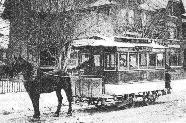
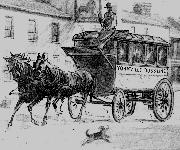
A city's commitment to its people, its regard for quality of life and amenities to enhance it, can be judged in no small part by the state of its transit system. Easy ways to get around -- widely accessible, inexpensive, and valued as a public trust -- mark a city meant for everyone, regardless of their private means. Much of Queen Street's history, development, character -- and perhaps most of all its place in the imagination of Toronto -- has been shaped by a distinctive form of public conveyance: streetcars. It wasn't the first street here ever to have them, but unlike many it has them still, on one of the transit system's longest surface rail routes. For 150 years, those asking their way in this town have often heard: "Take the Queen car." The term "carfare" has little to do here with private cars, but with the cost of a trip on public transit. It's a cost much easier on the budget (not to mention the environment) than the care, feeding -- and parking -- of one's own ton or so of rubber and steel; as the TTC says, it's "The Better Way." It certainly is on Queen Street: people living along its route are, on average, less likely to drive to work than commuters citywide; in some neighbourhoods fewer than half do. But in others, more people take the car -- their own, as they can afford to. The Beach, Queen's most affluent east end stretch, has the lowest level of public transit use anywhere along the street. As ever, those on whom money bestows "freedom of choice" are free to consume the planet's resources at whatever speed they choose. Public transit in Toronto began not public, even rather a luxury -- if hardly luxurious. The first scheduled service, offered by cabinet maker Henry Burt Williams in 1849, ran from the St Lawrence Market along King and up Yonge to the Village of Yorkville, in open horse drawn wooden omnibuses with room for all of six passengers at first, later ten. In 1861 Alexander Easton put the cars on rails (the first real streetcars if still horse powered) and got a 30-year franchise to run them as the Toronto Street Railway Company (TSR). The fare was five cents. So, at the time, was the average worker's hourly wage. As transit historian Ted Wickson has put it, "streetcar riders tended to be more affluent" -- if still having to settle in winter for no more warmth than offered by a layer of pea straw on the floor. The driver, stuck out front no matter the weather, got to stand in a whole box of it. The TSR began with 11 cars, 70 horses, six miles of track and some 2,000 passengers a day. In 1891 it was 68 miles, many more cars and horses, and 55,000 riders -- but by then Easton's franchise was up. The City took over, if without the resources to make public transit truly public. Within four months they signed a new deal with William Mackenzie (who with fellow rail magnate Donald Mann built the Canadian Northern; in 1919 and going bust, it would be incorporated with other lines -- by a Tory government -- into the publicly owned Canadian National Railways). Mackenzie's Toronto Railway Company (TRC) added electric cars, the first in 1892 on Church Street, and heat from small stoves in each. By 1897 -- if not without religious resistance and competition from "Methodist bicycle makers" -- there was even service on Sundays. Business boomed. So did the city. Transit lines spawned "streetcar suburbs," even distinctive forms of early 20th century architecture: the "streetcar apartment" (walk-ups of three or four storeys) and "streetcar houses" (inexpensive bungalows often duplexed, with deep porches, wide dormers and without stables or garages) spreading beyond the town's classic rows of Victorian "bay & gable." You can trace Toronto's growth on the ground by the style of each neighbourhood's houses, shaped by horse carriage, streetcar -- and later the "family car." The TRC's mandate, like the TSR's, also ran 30 years; its eagerness to fulfill it ran out sooner. By 1911 Toronto's population was 350,000 -- more than twice what it had been 20 years before. The City, having tried and failed (in court) to force the TRC to extend lines and improve service, filled the gaps with five new lines of its own. The Toronto Civic Railway (TCR) would later spawn others: the Toronto and York Radials (T&YR); the Toronto Suburban Railway (TSR); by 1921 there were four companies and nine operations -- none connected and all charging separate fares, ranging from two cents to 15.
| ||||
| . |
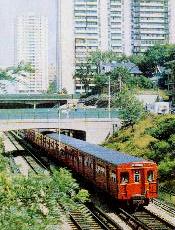
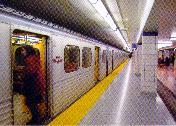
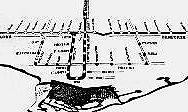
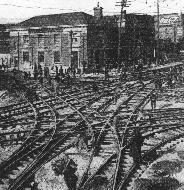
But by then the City had learned how to run a railroad. Or at least a street railway: on September 1, 1921 the Toronto Transportation Commission was born, a public body accountable to the city government and "responsible for the operation of all local public transportation, with the exception of steam railways and taxis." The TTC instantly bought 250 new streetcars (325 more by 1923), took over tracks and facilities the TRC had let fall into disrepair, and poured more than $30 million into expansion, upgrading and repairs. Bus service was added to rail, the TTC's Grey Coach Lines in time reaching other cities in the region. By 1927 the Commission ran boats too, taking over from private operators the ferry service to the Toronto Islands. As Ted Wickson wrote in a 1996 history of the TTC: "An old, dilapidated, fragmented transportation system had been rehabilitated and revitalized under public ownership." With the 1953 creation of Metropolitan Toronto -- one of the first urban federations anywhere, encompassing 13 municipalities, 240 square miles and more than a million residents -- that public system had a bigger mandate to fulfill. In January 1954 it got a new name: the Toronto Transit Commission. After nearly a century of rampant acronyms it seems a relief it nonetheless stayed, and remains, the TTC. For most across the 240 square miles of the City of Toronto (as it now is: the 13 municipalities of Metro, soon become six, were forced by provincial fiat into a single "megacity" in 1998), "TTC" means the subway. The first line opened in March 1954, running from Union Station just over four miles north to Eglinton Avenue, mostly under Yonge Street (or just east of it), some stretches north of Bloor in open cuts. In 1963 tunnelling began for a parallel line from Union up the other way, under University Avenue to St George station -- where by February 1966 it met the new east-west Bloor Danforth line. Later extensions of that U with its base at Union -- further up Yonge, and in the "Spadina ditch," cut for an expressway stopped by civic activists in the early 1970s -- now stretch nearly nine miles north of Queen Street. Queen has two subway stations on that U: one at Yonge called Queen; and Osgoode at University. It was once due to have many more of its own. In 1946, when voters approved funds for the line under Yonge Street, they also approved one under Queen. Early plans for the Bloor Danforth line (see one below) had it looping down at Christie Street to Queen, running east under it to Pape Avenue and from there back up to the Danforth. But that didn't happen. The entire east-west line, now 17 miles long, stayed more than a mile north of Queen; a new one now abuilding is more than six miles beyond that, under Sheppard Avenue. The city's centre of gravity has shifted ever north, massive development too, towers marching east and west along routes once rural concession roads.
Queen Street never got its subway; history left it behind. Had it not, we might well have lost much of its history, the street we know and the neighbourhoods flanking it likely long gone to "progress." The street does have a memento of the legacy it (happily) lost: beneath it are, in fact, not two subway stations but three. Deep under the platforms running north and south at Queen and Yonge there are others aimed east and west: a complete station, the only one on what was to have been the Queen line -- fully intact, I'm told, if never seeing a single passenger. They are all, thankfully, still up on the Queen car.
| ||||
| . |
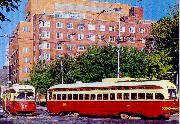
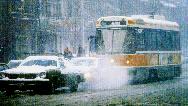
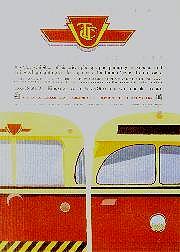
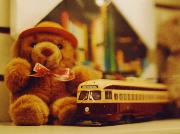
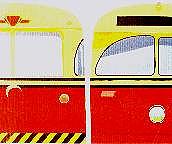
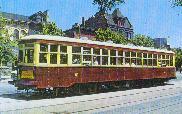
There has been a Queen car on Queen Street -- or parts of it -- since 1861, when the Toronto Street Railway's six miles of track lay along just three routes: Queen, King, and Yonge, concentrated downtown if running on Queen all the way west to Ossington Avenue. In time they stretched further, often to the city limits then current, sometimes not, if on some routes beyond: Parkdale, not encompassed until 1889, got a TSR line along Queen three years before. By 1887 tracks crossed the Don River to run east on what was then Kingston Road, later renamed Queen. The far east end of The Beach, annexed to the City in 1909, got TRC service only in 1914. By then there was a continuous route from Roncesvalles on the west to Neville Park in the east, and all along it there were streetcars. As there are today -- if not the same ones. On its birth the TTC launched its first vehicle of steel, not wood: the "Peter Witt" car, named for its designer. They remained a common sight on Toronto streets well into the 1950s, if already overtaken by a more modern trolley also named for its designer -- an international crew of transit honchos. The Presidents' Conference Committee car made its Toronto début in 1938, on display at the Canadian National Exhibition, its "streamlined" modernity an instant hit. In time its vaunted sleekness would come to seem chunky, the ride clunky; its interior appointments -- dark padded seats big enough for two; dull walls washed in the dim incandescent glow of bulbs behind round glass shades -- rather old fashioned, even frumpy. But also comfy, familiar; hugely so: by 1953 Toronto had 715 PCC cars, most built in Canada -- the world's biggest fleet. Faced with that fleet's aging, the TTC pondered the transit route along which many other cities had been pushed (with a hand from General Motors): scrapping streetcars in favour of busses deemed more "modern, flexible and cost effective" -- likely by bean counters who ever ignore social costs that don't show up on their own books. On some routes (among them Harbord, Mount Pleasant, Church) the TTC did give us what much of the world thinks of as public transit: the roar and diesel stink of lurching GM "coaches." But in 1972, suspecting the streetcar had a future, they decided to stay old fashioned -- and order new ones. The first gleaming new LRVs (for Light Rail Vehicles now built, along with our subway cars, in Thunder Bay) rolled onto the tracks in September 1979. Soon all but a few PCCs had rolled off -- sadly missed. The comfortable old maroon and cream livery detailed in black had gone to bright red and white; the soft shared seats to separated ones slung in chrome; windows one could slide up, even lean out a bit (if of course warned against it), to bigger ones fixed but for a small low panel opening just a few inches wide. The bold route names over the windshield -- King, Dundas, Queen -- were gone (even on the last PCCs) to 504, 505, 501. It was no longer, even officially, the old Queen car. Some now are not even red, but IBM blue or Guinness nut brown, as the cash- strapped city rents out its public surfaces for private promo, entire streetcars decked out as rolling corporate billboards. Well, a trolley's just a trolley I suppose. But no other means of transit in this town has ever become an icon: PCC cars were classic Toronto. They can still be found in civic imagery: as transit promo; art in new subway stations; in posters and paintings portraying life on the city's streets, Queen especially -- there it is: the original Red Rocket. You can still take one home: die cast steel models in full livery and fine detail are on sale at the Publications and Resources Centre in Toronto City Hall. The TTC still urges us to "Ride the Rocket." I do, if not the one of memory: streetcar rides inspired this work (and the colours here, much like the old Red Rocket's). I'd ride along Queen, King, College, Roncesvalles, pondering what I saw, what makes a good urban streetscape: human scale; random variety; mixed uses, old buildings put to new ones; the civil pace of feet. And of streetcars. In short, urban life; public life. The sort of life accountants can't count, don't much like, and -- in the name of "privatization" -- hope to kidnap. Public amenity is under seige everywhere, Canadian cities barely able to defend it even when they want to. They are wards of provincial governments, made so as urbanologist Jane Jacobs has said "in almost the same breath as taverns and asylums," confined by rules written in 1867 for a nation of farms, villages, and small market towns. Since 1998 the new "megacity" of Toronto has been one of the world's only major urban centres whose transit system gets no funding from higher levels of government. Fares cover nearly 82 percent of the TTC's costs -- one of the highest figures anywhere. For the rest it's stuck depending on the new city's limited property tax base; suburban politicians, our new megamayor among them, get elected on the promise of keeping taxes low -- even if too low to preserve the amenities of urban life. Some just don't get it: when City Council considered reserving King Street at rush hour for transit vehicles, a pol there said: "Why not get rid of the streetcars? They just get in the way of cars." As service gets slower, less frequent, more crowded, "TTC" becomes a joke: "Take The Car." Your own. That's how privatization works: rob the common weal to the point of public misery, then tout a "better way": private, profitable, comfortable; even -- as ad flacks so love to say, conscious or not of the term's true import -- "exclusive." So: let's take the Queen car while we can. If the people of Toronto stay savvy, mindful of their town's public life, we may be able to take it for quite some time to come.
Sources (& images) for this page: Christopher Armstrong & H V Nelles: The Revenge of the Methodist Bicycle Company: Sunday Streetcars and Municipal Reform in Toronto, 1886 - 1897. Peter Martin Associates, 1977. Toronto Transit Commission: Transit in Toronto, 1984. Margaret Laycock & Barbara Myrvold: Parkdale in Pictures, Toronto Public Library Board Local History Handbooks: No. 7, 1991. Mike Filey (preface by Ted Wickson): The TTC Story: The First Seventy Five Years. Dundurn Press, Toronto, 1996. Ron Brown: Toronto's Lost Villages, Polar Bear Press, Toronto, 1997. All images courtesy of the Toronto Reference Library & the Toronto Transit Commission. For sources cited throughout, see Life on the street. Go on to: Public libraries (This needs a real title)
Or go back to:
This page: http://www.rbebout.com/queen/ttc.htm
|